Prime Minister Gaston Browne, speaking on his own radio station, recently claimed that Antiguans and Barbudans are earning “five-figure incomes” managing luxury villas. It was presented as proof that high-end tourism is delivering prosperity for locals. But when placed next to actual labour-market data, international assessments, and the documented structure of enclave tourism in the Caribbean, the claim collapses instantly.
What remains is a political fantasy — not economic reality.
⸻
Tourism Dominates Our Economy — Yet Locals Are Not Advancing
Tourism already accounts for nearly 60% of Antigua and Barbuda’s GDP, according to the UN’s SIDS economic profile. That same data notes that tourism drives around 40% of investment and dominates the services sector, which makes up roughly 77.5% of national GDP. (Source: UN SIDS Profile – Antigua & Barbuda)
If luxury villa management were truly lifting locals, this would show up in employment outcomes. Instead, UNICEF and the OECS report that:
• Youth unemployment is 26%, compared to 6% for adults.
• Only 36% of young people (15–24) are employed.
• 18% of youth are NEET — not in education, employment, or training.
The Antigua & Barbuda Labour Force Survey (2018) confirms the same pattern: youth unemployment at 25.7% — four times higher than for adults aged 25–54. (Source: Ministry of Labour / Labour Force Survey Report)
If “five-figure villa jobs” were genuinely available to local youth, the national labour profile would not look like this.
⸻
What Does ‘Five Figures’ Even Mean?
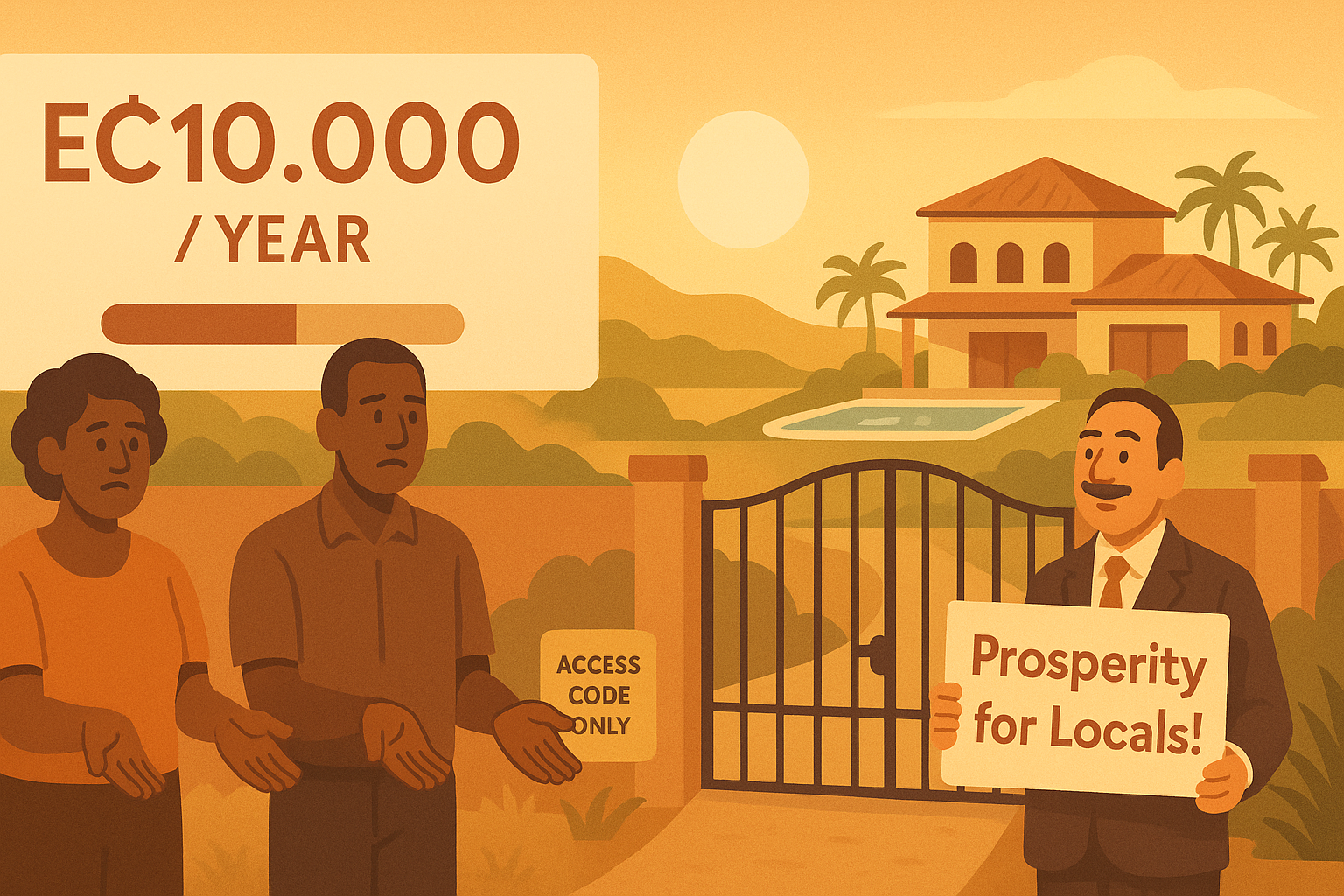
A “five-figure income” in EC dollars can be as low as EC$10,000 per year. That is poverty — not prosperity.
Regional salary surveys consistently show that hospitality workers in the Caribbean, including Antigua and Barbuda, typically earn low five-figure EC incomes annually, often without benefits, job security, or advancement pathways. (Sources: Paylab Caribbean Salary Survey; World Salaries Database for Hospitality Workers in Antigua & Barbuda).
Labeling this wage band as “proof of prosperity” is dishonest.
⸻
The Apartheid Geography of Enclave Tourism
What is happening around luxury villas in Antigua and Barbuda matches a wider Caribbean trend documented by multiple international bodies:
World Bank / Tourism Sector Analyses
Studies show that foreign-owned luxury developments create “enclave tourism” — self-contained resorts with weak domestic linkages, generating “limited local development” despite high overall revenue.
(Source: World Bank – Caribbean Tourism and Inclusive Growth Reports).
Americas Quarterly on Barbuda Ocean Club
Investigative reporting on Barbuda notes that luxury estates have resulted in “luxury enclaves that local people do not have access to,” creating spatial exclusion and undermining traditional community life.
(Source: Americas Quarterly, “Barbuda: The Cost of Luxury”).
Marine biologist and Chairman of the Barbuda Council John Mussington describes these developments as extinguishing longstanding Barbudan community structures in favour of ultra-wealthy outsiders. How does this setup benefit locals?
Social Impacts Echo Apartheid-Style Buffer Zones
A Jamaican commentator, quoted in the same Americas Quarterly report, observes that a wall goes up, a billionaire arrives, and what remains is “an under-employed, under-resourced native population living beside zones of exclusion.”
That description mirrors the socioeconomic logic of Bantustans in apartheid-era South Africa: buffer zones and walled worlds of privilege serviced by a racialized labour force with restricted mobility and limited opportunity.
⸻
Imported Labour Dominates High-End Properties
Even on paper, Antigua and Barbuda is supposed to prioritize local workers. The WTO’s Trade Policy Review states plainly:
“Foreign workers may only be employed when qualified nationals are unavailable, subject to a labour market test.”
(Source: WTO Trade Policy Review – Antigua and Barbuda).
In practice, international assessments tell a different story. UNICEF’s regional labour-vulnerability report documents the presence of imported workers in Antigua and Barbuda, including:
• Migrant labour from Jamaica, Guyana, the DR and elsewhere;
• Workers who, in some cases, become victims of forced labour or trafficking within tourism-related sectors.
(Source: UNICEF Caribbean – Child Protection Snapshot / Trafficking and Labour Vulnerability Overview). This is our reality, and this imported labour feeds a hierarchy in which:
1. Foreign billionaires own and control land;
2. Imported “expert” managers occupy mid- and high-level service roles;
3. Local workers are left with the lowest-paid, least-secure position – glorified maids and janitors.
This is not upward mobility. It is a care economy wrapped around someone else’s wealth.
⸻
The Plantation Logic, Updated and Rebranded
Scholars of Caribbean tourism have long described the industry as neo-colonial in structure. Academic analyses show that the Caribbean tourism model:
• Reproduces colonial racial hierarchies where Black labour serves white wealth;
• Concentrates capital ownership offshore;
• Limits locals to service roles such as housekeeping, groundskeeping, cooking, and basic maintenance.
(Sources: UWI Tourism Studies; “Postcolonial Tourism in the Caribbean” – Peer-reviewed analyses; Caribbean Labour and Migration Studies).
The “villa manager as success story” myth ignores this entire power structure.
Our ancestors did not survive slavery, contract labour, colonialism, and structural exclusion for their descendants to become — in effect — uniformed attendants in fenced-off enclaves marketed as national development.
⸻
What Real Opportunity Would Require
Antigua and Barbuda will not break this cycle unless it demands:
• Transparent labour data: disaggregated by nationality, gender, hiring level, and pay scale.
• Enforceable local-hire quotas, independently audited.
• Investment in tertiary education, technical training, and entrepreneurship, so young people can enter management, ownership, engineering, design, architecture, finance, and the creative economy.
• Protection of shoreline and communal land rights, preventing the creation of Caribbean-style Bantustans.
Until then, talk of “five-figure incomes” is not an economic plan. It is an evasion.
⸻
Our Children Deserve a Future Bigger Than a Gate Code
The model being praised on the Prime Minister’s radio station is not one that develops a nation. It is one that polishes a spectacle: the wealthy behind gates, locals at the margins, politicians calling crumbs a feast.
Our children are not being prepared for autonomy, innovation, or ownership. They are being prepared to serve.
And our ancestors’ sacrifices deserve more than to be invoked in defence of a system that recreates — with better décor — the very hierarchies they fought to dismantle.
The talk of “five-figure incomes” is a farce.
The reality is a deepening divide.
Antiguans and Barbudans deserve better.